The
Problem
Design an app and a check-in kiosk
Hotel Next set out to redefine hospitality by eliminating the traditional front desk entirely. The brief started small: a guest mobile app and a check-in kiosk.
An app alone can't replace a front desk
A hotel spans three distinct layers: the customer experience of booking and pre-arrival, the guest experience of physically navigating the property and getting into a room, and the staff experience of actually fulfilling requests. Guests are also historically reluctant to download a native app for a short stay. If someone arrived without an assigned room or a working digital key, the entire deskless model would collapse into lobby chaos on day one.
A download wasn't the finish line
Mapping the customer, guest, and staff layers together surfaced something specific: making booking confirmation app-exclusive got nearly every guest to install the app before arrival. But installing the app wasn't the same as being ready to skip the front desk, a guest still had to actually complete identity verification and room assignment before ever reaching the lobby.
Signage and kiosks had to stop being furniture
Digital signage and interactive touchscreens couldn't stay passive decoration. They had to become the property's primary operational infrastructure, and app installation had to be treated as step one of a qualification process rather than the whole solution.
I re-engineered signage and kiosks from secondary displays into the property's primary operational backbone.
To guarantee guests arrived already qualified, I designed a three-touchpoint pre-arrival loop: an app-exclusive booking incentive, native calendar sync, and timed contextual push notifications. Completing all three meant a guest showed up with a room already assigned and a digital key already live, before ever stepping into the lobby.
One CMS,
Every Screen
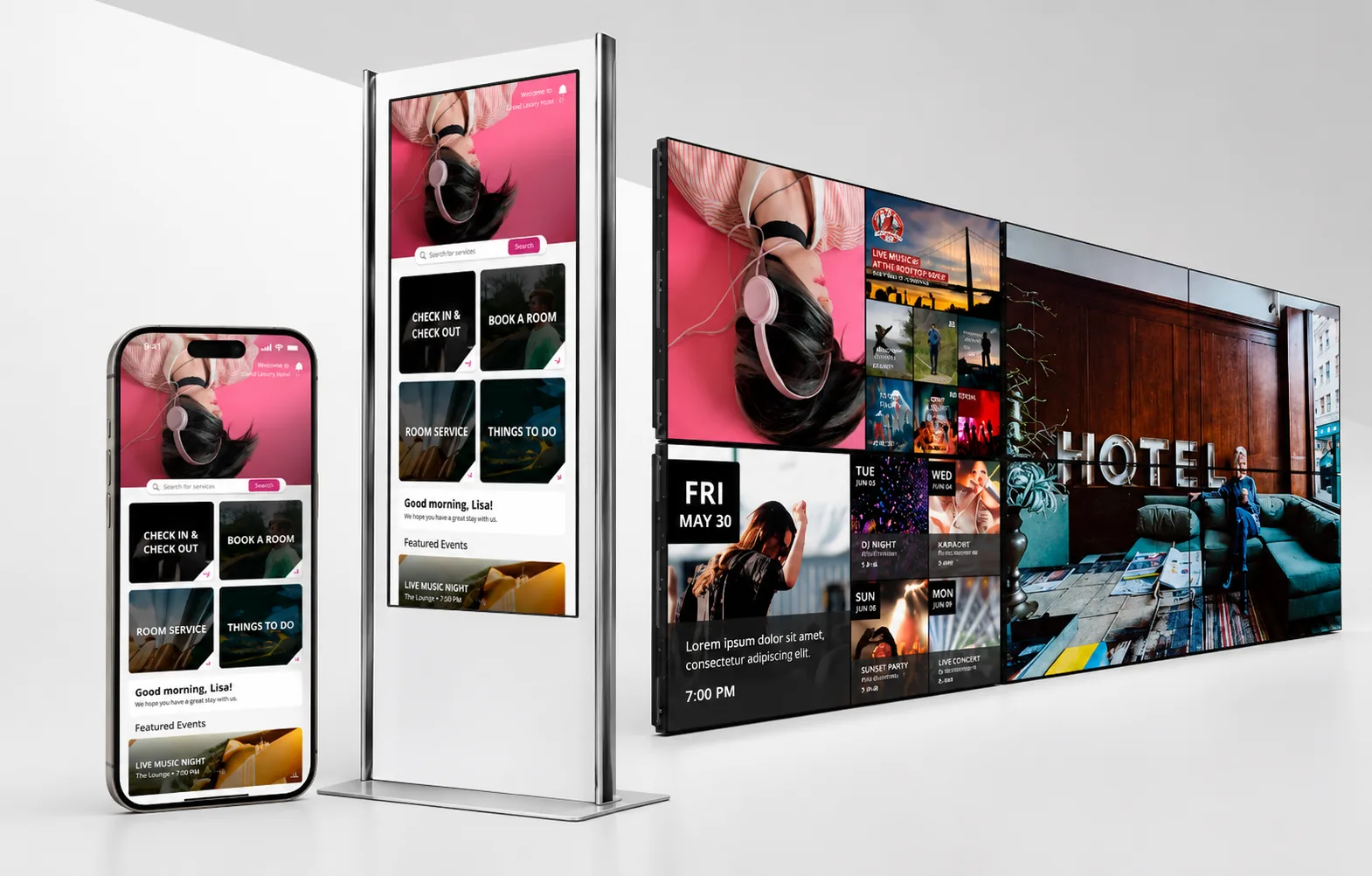
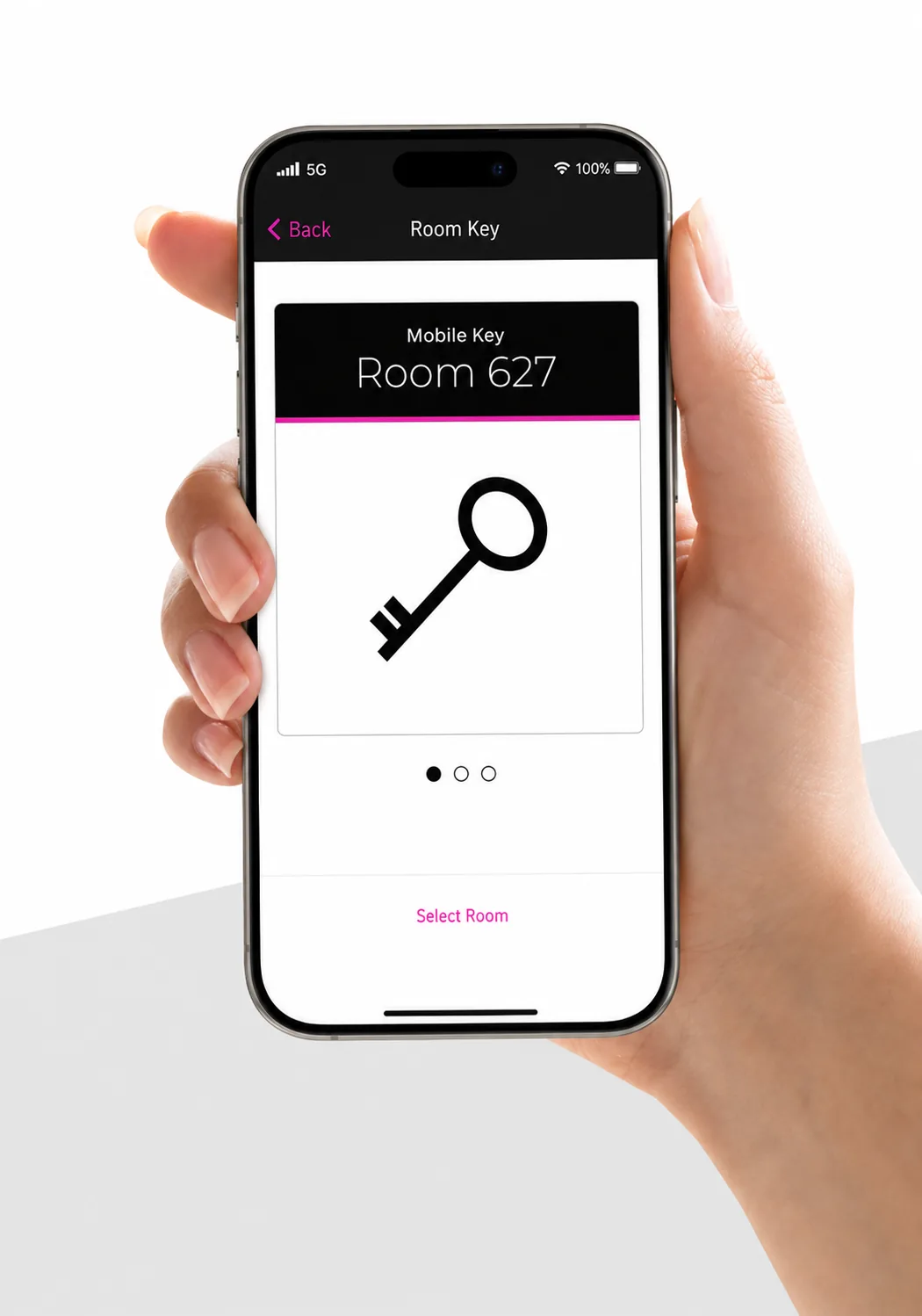
The mobile app became the guest's personal control panel, booking, check-in, door key, room service, and navigation in one place. Kiosks extended the same functions to anyone without the app or mid-stay. Because all three surfaces drew from the same CMS, an action started on a phone showed up instantly on the screen in front of the guest. Beacon-based AR and voice-assisted navigation guided guests to their room the moment the door unlocked.
Inside the
Ecosystem
The pieces that let the front desk disappear.
Making touchscreens and video walls the primary point of contact eliminated the physical front desk. A guest without the app, or a mid-stay visitor, could self-check-in, browse the concierge listings, or file a service request at any wall or kiosk on property, with the state reflected instantly everywhere else.
- Booking hook: app-exclusive booking confirmation and perks, so installing the app was the only way to get the booking confirmed.
- Native calendar integration: stay dates synced automatically into the guest's own device calendar, with direct links back into the app.
- Contextual push protocol: timed notifications prompting pre-arrival ID submission and triggering automatic room assignment on approval.
Completing all three loops guaranteed the guest arrived on property with a pre-issued digital key. A guided tutorial and gamified interactions kept engagement high through the process, and offline verification support meant it still worked without a reliable connection.
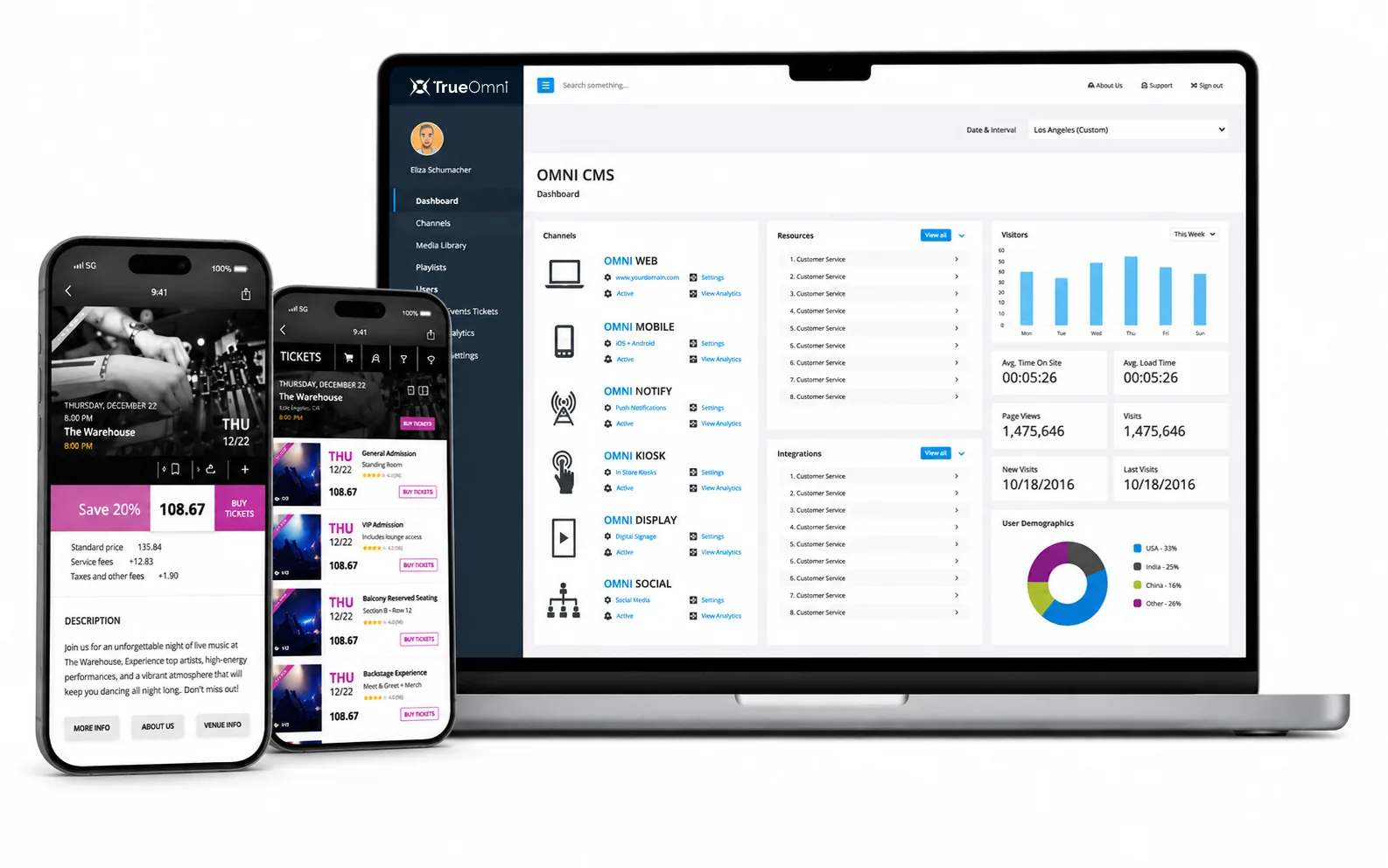
A single CMS kept promotions, services, and concierge content synced in real time across every screen on property. Behind it, room service, amenity bookings, and luggage requests triggered notifications routed automatically to the nearest available staff member through a connected staff app, driving response times down to under five minutes.
Shipped across TrueOmni's hospitality environments: app, kiosks, video walls and one shared CMS.
For basic guest requests, routed automatically to the nearest available staff member through connected devices.
Deskless. Check-in, room assignment, and door access all handled through the app and kiosks, no front desk queue left at all.
Looking
Back
What Went Well?
One App, Whole JourneyA single app carried the guest across the entire stay, booking, check-in, door key, room service, and navigation, instead of fragmenting the experience across separate tools.
Instant Digital-to-Physical ResponseFrom door unlock to service requests, digital actions produced an immediate real-world result, which is what made the deskless model feel trustworthy rather than gimmicky.
Front Desk Removed Without Losing the Human TouchStaff shifted from a fixed desk to a connected dispatch model, still present and responsive, just no longer the bottleneck.
A Scalable FoundationOne app, one CMS, many screens, gave leadership a concrete way to picture hospitality without a lobby queue, and a model that could roll out across future properties.
What Could I Have Done Better?
Edge-Case Bluetooth Lock FallbacksReal-time door unlocking via mobile performed exceptionally well overall, but designing clearer visual diagnostic feedback on the physical door hardware during rare Bluetooth latency spikes would have further reduced guest hesitation in those edge cases.